Hello and welcome to the latest blog from The Olivia Rose Diaries on August 8th 2024.
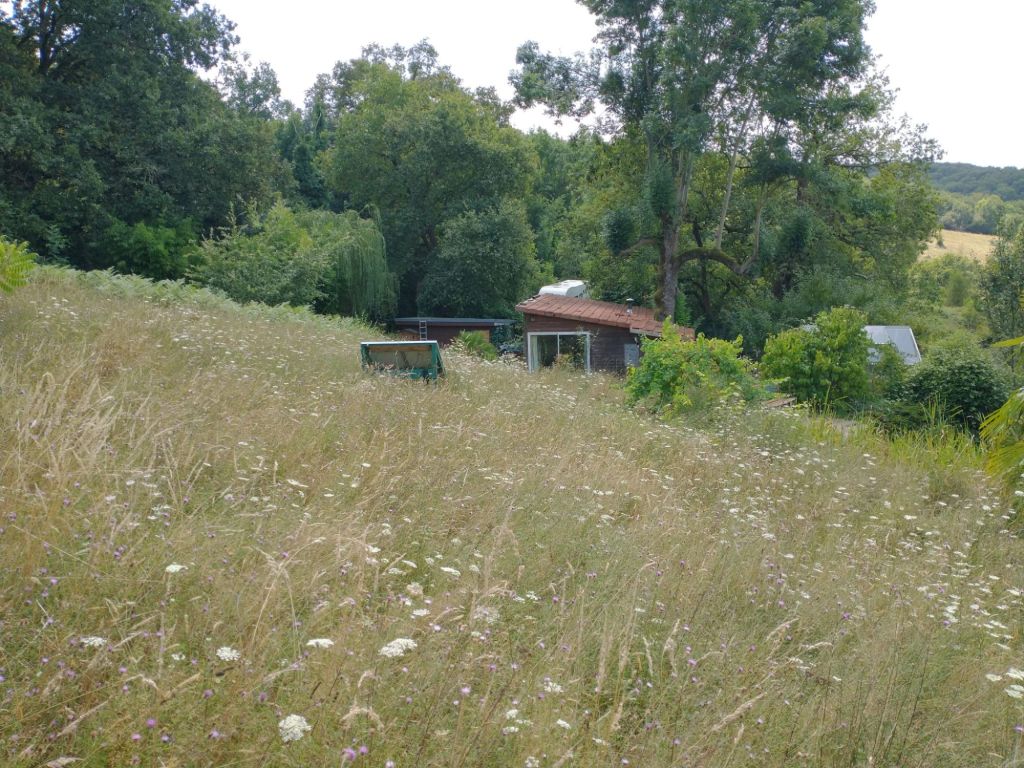
Late summer every year we return to our cabin home, Le Shack, near the Pyrenees after four to six months away on our boat. When we left our home in the spring the borders had been weeded, the grass immediately around the cabin was neat, and the rest of the field had been tamed after its annual cut, after which we leave it to grow wild. By the time we come back however, nature has completely taken over, and done so with great vigour and enthusiasm.
The first clue as to how much hard work we are facing comes at the front gate. A metal grating gives us access over a small stream which runs down the side of our land. The stream bed is usually almost dry by this time of the year, but it provides a fertile base for ash seedlings to take root and then push their way through the open grating. We have to pick our way over a mini-forest, interspersed with tendrils of bramble that snag on my legs as if to say I am not welcome here. I can imagine the look of weary resignation from our post lady as she has seen this obstacle course grow higher each month, making it ever more challenging to reach our mail box.
Le Shack is situated in the corner of approximately two acres of field, all now waist-high with grass, wildflowers, and many more oak and ash saplings, which is good, but also bramble, bracken and gorse which is not quite so good. The track that runs across the field, one that we keep mown as our second point of access, has disappeared as if it had never been. The wisteria, so elegant and refined when we left, has grown into a monster after a summer of rampant growth and wrapped itself in a death embrace around the wing mirrors and roof of our old campervan, showing no sign of being willing to let go. A little further up the hill is the caravan, which I use as my writing room, but this track is also completely overgrown and the brambles are climbing up the door.
Further down the hill, below the cabin, the composting bins have become a mound-shaped support for wild honeysuckle. The small flower beds around the cabin are full of weeds, the pond is choked with algae, and the spiders have claimed ownership of our outside composting loo and adjoining summer kitchen, which sounds grander than it is, being no more than a sink and drainer.
Armed with a broom I begin the fight to re-establish our right to go to the loo without fear of a spider descending from the rafters above or of walking into a web sneakily placed at head height. The size of the some of the webs, not to mention their inhabitants, is worthy of respect but I can feel my face screwing up in distaste at the collection of dead bodies held fast in those silky threads: a wing of a butterfly, what might have been a cricket in another life and sundry small body parts of insects and flies. Looking more closely I realise that there are two very large spiders that also look past their best. As I gently poke the web with a stick, a smaller spider scuttles across in the hope of lunch and, realising that it’s a false alarm, disappears inside what is left of one of its larger brethren.
It’s not all bad news. We have returned a few weeks earlier than usual and the wildflowers are still out en masse, jostling for space and creating a tapestry of lilac and cream, while the butterflies delicately pick and choose the best specimens. I’ve already seen a praying mantis, plus a rather alarming big white bug that I haven’t yet been able to identify.
Wildlife tracks weave through the tall grasses and we found fox droppings two paces from our front door. They never come that close when we are in residence and the thought crosses my mind as to who the intruder is here. We bought this property and feel that we own it, but the wildlife was here long before we were and has no awareness of human money and what it buys.

Each year we return to this scenario and each time I find myself awestruck at the irrepressible force of the natural world. It is simply unstoppable. We humans do our best to tame it, endlessly toiling in our gardens, cutting, clipping, weeding and trimming, week-in, week-out, as obsessed with keeping everything tidy as nature is determined to be wildly unruly. Out in the wider world we concrete over it so that we can build our cities, homes and factories or spray it with pesticides to protect our crops.
How would it feel if the human race suddenly disappeared from the earth? As you can see I experience the answer to that question every time we return home after a long summer away, but what I see is the effect on one small patch of land over just a few months. The consequences would be much harder to imagine and understand on a global scale.
Perhaps one of the first things we would notice would be how much quieter it was. No planes, trains, lorries, cars or tractors. No lawnmowers and chain saws, no forklift trucks and air-conditioning units humming away night and day. No human voices. We had some experience of this during the first pandemic. We returned to Olivia Rose in France four days before the first lock-down in 2020. Suddenly there were no cars on the road, no children in the school playground. That abrupt tumble into a silent world was surreal and I can still recall how it shocked me.
If we were no longer here it’s likely that the wind and the rain would slowly wash away the smog, dust and pollution that we used to produce every day. Skies would be more vividly blue and the air would become cleaner. With no-one to maintain our national grid, the pumping stations would fall silent, flooding the underground transport systems. With no-one in charge of oil refineries and nuclear plants there would be sporadic fires and explosions. In our homes there would be no heating, no lights, and the water pipes would burst after the first frost. Our gardens and parks would very quickly look just like our own wilderness does now, whilst tree roots would push up through pavements and cities would become forests.
For the natural world this sudden lack of human activity would set off a chain reaction of a different nature. There are many different possible scenarios but one of them imagines that without the steady release of pesticides, chemicals and other pollutants, insect life would proliferate, in turn leading to greater pollination of plants. Animals, birds and insects would flourish as habitats naturally restored themselves, the larger predators would slowly return and the food chain might just re-balance itself. Human noise would be replaced by a cacophony of buzzing and chirping and the creatures who had felt the need to hide in the woods and wild places in order to survive whilst humans dominated the planet would gradually build up the confidence to walk openly once more.
It provides some small solace to think that the planet could restore balance and carry on without us, even though it would take thousands of years for the type of changes described above to take place and there are many other factors that could derail the process. And the consequences of climate change, the legacy we leave behind us, are set on a course that won’t stop just because we are no longer here.
Our time living in this very special patch of wilderness has taught us that there are some battles you can’t win. Each year the part of the field that we call ours gets a little smaller and the part belonging to the wildlife gets bigger. We do our best to hold back the invasive species that would be detrimental to the diversity we so enjoy but, mostly, we leave nature to glory in her excess.
There is one area where we take no prisoners however and that is our composting loo. There are some lines that cannot be crossed and I know that tomorrow I shall be back out with my broom again after the spiders have had a busy night spinning away. It might take me a few weeks but this is one battle I know I can win and there is no shame in small victories.
See you again soon.
 The Olivia Rose Diaries
A most excellent insight to our planet without humans. It reflects my own thoughts, except nature would envelop our structures quicker than one would expect. Such an event might not be too far away if we humans continue on the course we currently seem to be unable to deviate from. Cheery thoughts! Enjoy your own little piece of paradise with far more wildlife than most of us experience on our doorsteps.
LikeLike
Hi Antony. It’s a two edged sword isn’t it? A question of where our personal tipping point is for chaos versus order. A moveable feast in our case!
MJ
LikeLike
It is amazing how quickly nature takes back its domain. After 10 days in Sweden, our garden was jungle-like, and that was in July! The rain this year has encouraged even more abundant growth than usual. The brambles and ash saplings are the beneficiaries, along with a variety of other weeds that have developed like triffids! We often say that it wouldn’t take long for our immediate environs to revert to woodland if the farmers didn’t keep the fields open (mostly pasture around here). It’s frightening what humankind has done, but in a way heartening to know that nature can still fight back.
LikeLike
Hi Vanessa. It certainly does!
MJ
LikeLike
Looks like there is enough to keep you busy for a while carving out a niche for yourselves in that wilderness. Has the kitty graced you with a return visit yet?
LikeLike
I also wanted to ask if you’ve ever read the book ‘The World Without Us’ by Alan Weisman? He imagines the world without humans and how quickly nature would take over… Chernobyl is a prime example.
LikeLike
Hi Eliza. No but I shall have a look. Thanks for the tip.
MJ
LikeLiked by 1 person
I found it fascinating.
LikeLike
Hi Eliza. Not yet. Always takes a while. I shall post a pic on blog when she does!
MJ
LikeLiked by 1 person
Seen Spot yet?
LikeLike
Hi Tracey. No but not surprised. Sometimes it takes three weeks and in this heat she’s probably not patrolling her territory so much.
MJ
LikeLike
Interesting post, MJ. I watched a movie one time, I wish I could remember the name of it… something like If We Left or something along those lines. It showed what NYC would look like if there were no humans. One year, five, 10, 25, 100. Astonishing. Anyway, thx for a thought-provoking post. Le Shack looks beautiful 😎
LikeLike
Hi Darryl. Glad you enjoyed it. Yes, Shack is a special place.
MJ
LikeLiked by 1 person