Hello and welcome to the latest blog from The Olivia Rose Diaries on June 4th 2024.
A bird of prey glides low over the marshes, hooked beak and sharp eyes scanning the ground below. Without warning it drops and stays down, hidden in the long grass. I wait, but it it doesn’t fly off again so I assume it’s caught a mouse or a vole. It looks a bit like a buzzard but its body is too slim. It could be a kite but the colouring is wrong. We know enough about birds to know what it isn’t, but we have to resort to our bird book to find out what we are looking at. It’s a marsh harrier, a new bird for us, one which nests unseen in the tall reed beds that line the waterways and ranges over these endless wetlands, picking off mice, voles, small birds and insects.
A bird with bright orange-red legs and a long beak flies off from a fencepost as we pass by and the book has to come out once more. It’s a redshanks, a wading bird. Our next encounter is a bird we know very well, a grey heron, but we can’t initially work out what it’s got in its beak.
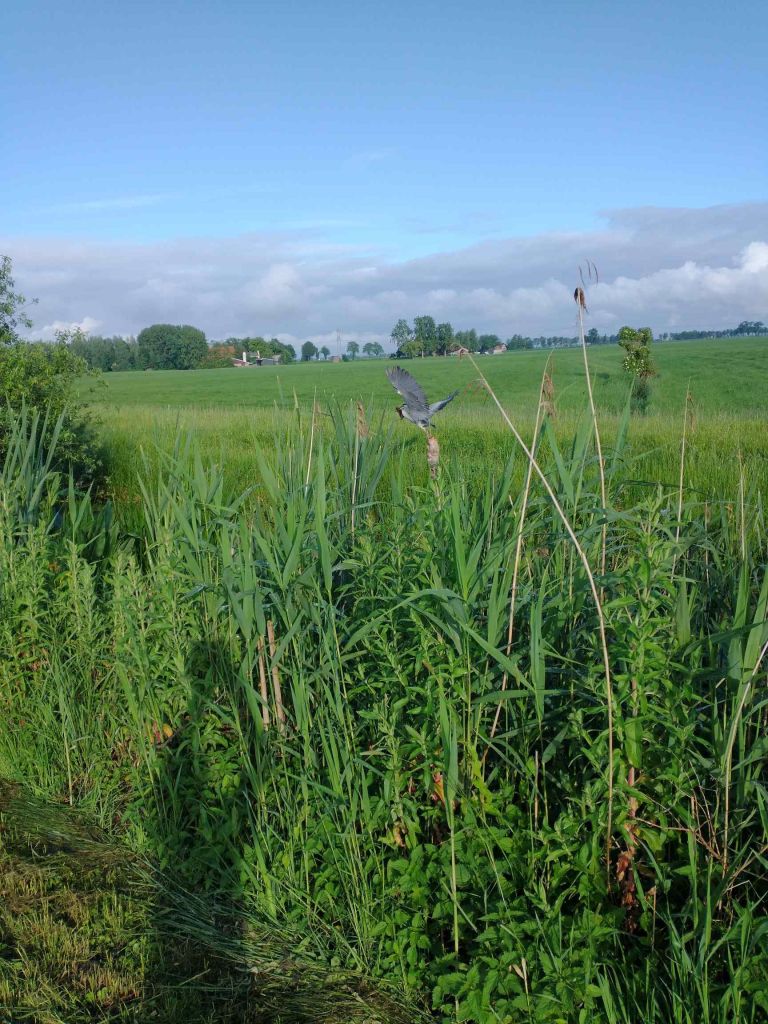
It turns out to be a black rat. I can see it’s tiny legs scrabbling madly, its tail thrashing in a bid to wriggle its way out of trouble, but its fate is sealed. Herons are opportunistic feeders but this is the first time I’ve seen one catch a rat. I’m fascinated to know how the heron is going to get this unfortunate rodent down its neck without losing it, but it is obviously not pleased by our attention and flies off, rat firmly clamped in its beak, still kicking. I peruse YouTube later that day and find numerous videos of herons swallowing rats. Fascinating, as long as you’re not a rat.
We are still in Friesland but we have left the network of huge recreational lakes behind us. We are taking the Turf Route and our world has shrunk to a small canal cutting through what used to be extensive peat beds. In the second half of the 18th century, three ‘lords of the peat’ saw that there was profit to be made from these ancient swamplands. Peat was cut, dried and used for fuel in homes but the workers gained little from it. They endured long working days and poor pay in harsh conditions. Once the peat had been cut it was shipped out to customers along a network of canals.
That industry has long gone but the canals remain. However these canals are not just narrow, they are also quite shallow and we are not entirely sure that we will make it all the way through.
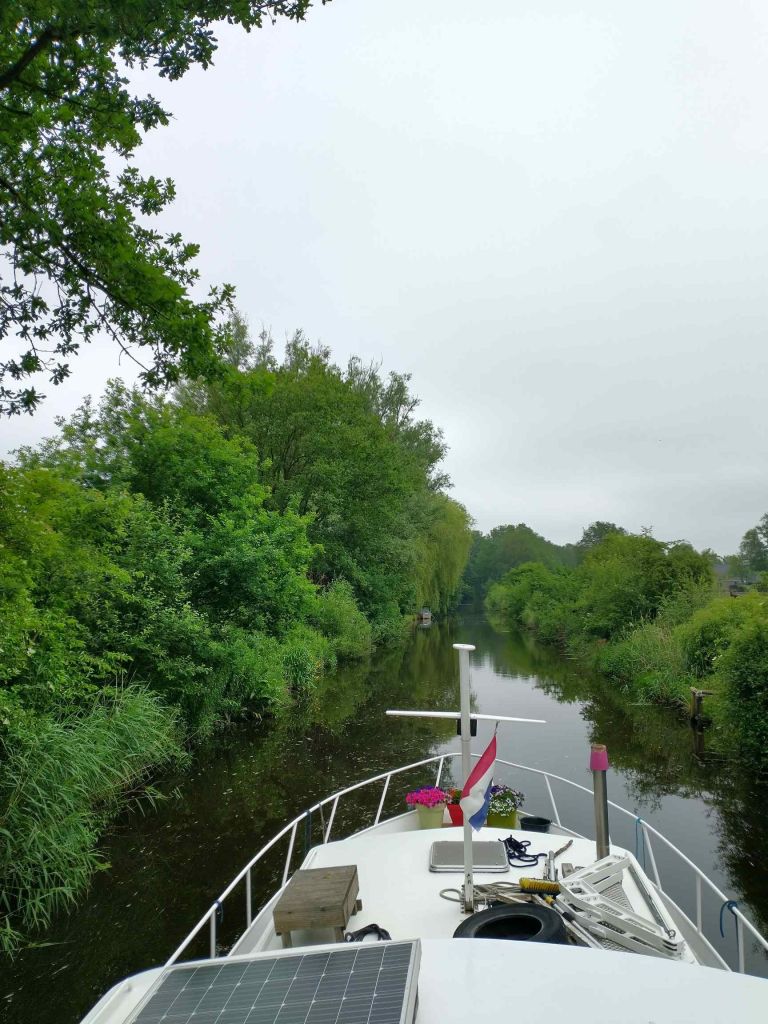
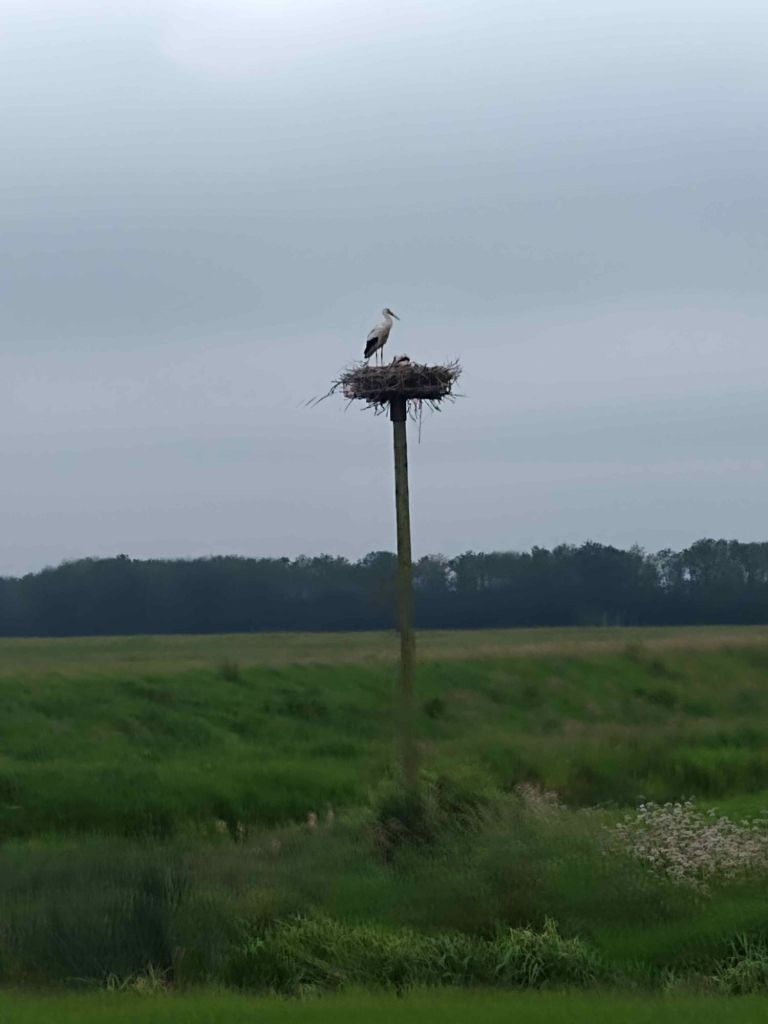
The yachts with their deep keels and high masts can’t come down here and its too narrow for the massive gin palaces that frequent the marinas around the lakes. Much to our surprise and delight we see only one other boat on our first day, and that passing in the opposite direction, a fleeting encounter. Instead we see a deer, raising a startled head as we glide past, and a kingfisher, the first we have seen this season, a flash of midnight blue darting in and out of the tree-lined banks. It whistles a triumphant now you see me, now you don’t as it disappears from view. A stork feeds its young from its nest, a great mass of interwoven twigs, solid and dependable-looking despite being perched on a high post.
The canal cuts straight through the middle of a few small towns on its route. We see people cycling to work, calling out hello to people they know, sometimes stopping to chat. Everybody knows everyone else and the pace is slow and sleepy.
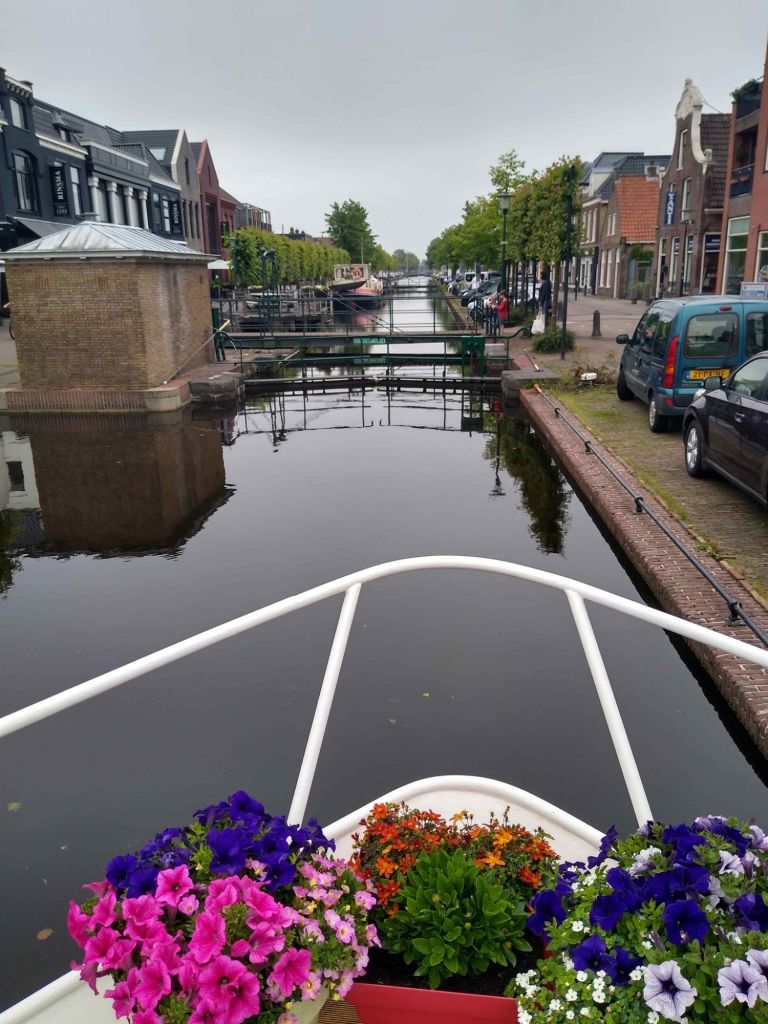
As we go through the lock in Gorredijk a mother explains how it works to her two young sons. We can’t understand a word but there is enough finger pointing for us to get the gist. Her youngest son gets bored and launches himself at the railing, scrambling to climb up and over, and the lesson comes to an untimely end as she hauls him back down again.
These bridges and locks are operated by people who just work for the summer season when the canal is open and much of it is manual. When we ask them what they do for the rest of the year we find that we are in the company of people who have a restless nature. One man spends the remainder of the year in Thailand, another splits his year into three segments, one in the Netherlands, one in Greece, one in Spain. He is learning Spanish, something to pass away the time when the canal is quiet. He already speaks excellent English and German as well as his native Dutch.
Some of the smaller swing bridges, often just a footbridge, are worked by small boys, barely strong enough to push the bridges open, but very quick to swing out a clog on a piece of string in the hope that we will pay them for their help. I trickle a handful of small coins in, no more than 20 – 30 cents and can’t help but smile at their hoots of delight as they squabble over their bounty.
Occasionally there is no-one to work the bridge and so Michael drops me off on one side, I swing it open, shut it after he passes and hop back on board. With a total of 5 locks and 20 lifting bridges to negotiate it takes us 6 hours to do 22km, an average of just under 4 km per hour. Lunch is a sandwich on the go.
This really is slow travel, more typical of France rather than the Netherlands, but it was a good day. If you go slowly you talk to people, you can watch them as they go about their lives and, equally importantly, you have the time to watch the reed beds and the skies, the trees and the rippling grasslands and, with a little patience and a lot of luck, they too have much to share.
The rural moorings are generally free, and we paid only 7.5€ in the small town of Gorredijk. Electricity and water is available from a coin operated metre if you want it. We spent last night in the town of Oosterwolde, with the added bonus of an ice-cream shop in view of our mooring, one that stays open until 2100 hours (the Dutch are great ice-cream lovers and many specialist ice-cream parlours will have thirty or more different flavours). Tonight we are back out in the marshes on a small rural mooring. No street lights. No cars. The only downside? No ice-cream.

Tomorrow we leave the Turf Route and in a way it will be a wrench as we have loved the peace and the emptiness. However the road leads ever onwards, or the water in our case, and it must be followed. See you again soon.
MJ
 The Olivia Rose Diaries
Away from the cares of the world, no wars, no elections! Bottle it!
LikeLike
Hi Tricia. If only we could!!
MJ
LikeLike
Given your as ever your excellent description of the natural world you are passing through, I would want to go far slower than you. What is round the next corner could wait!
LikeLike
Hi Antony. We have got much better at going slower but there is still room for improvement I am sure!
MJ
LikeLike
The slower pace sounds kind of dreamy. ‘Messing about in boats’ like in The Wind in the Willows. 🙂
The ice cream definitely sounds great! Have a pleasant week.
LikeLike
Thanks Eliza. I am working my way through all the different flavours.
MJ
LikeLiked by 1 person
The Turf Route sounds wonderfully tranquil and is clearly a haven for wildlife. Good for the soul.
LikeLike
Hi Vanessa. It certainly is.
MJ
LikeLike
Yes, I agree – a wonderfully evocative piece. Calmed me just reading it. Roll on summery weather though!
LikeLike
Hello Ian. So glad you enjoyed it. We’re in full winter gear today! Ridiculous. Back out in a lake shortly so will be blown and bumped all over the place. It’s always windier than the forecast says it is! Will be very happy for some warmth. Made the mistake of looking at the weather at least Shack today. 29 Deg. Wall to wall sunshine. No comment. Regards. MJ
LikeLike
As you are less than 10 kms south of us, moored at Drachten, waiting to leave to travel to Dunkerque on the 17 June, are you planning to ‘sneek’ up on us? Love you blog as always. Hope the sunshine comes out when we arrive….
LikeLike
Peace and nature……sounds lovely!
LikeLike
Hi Sue. Indeed. Although sun would make it even better!!
MJ
LikeLike