Hello and welcome to the latest blog from The Olivia Rose Diaries on May 26th 2024.

The Netherlands is a small, densely populated country and, unless you have escaped to an island in the middle of a lake, you are never far from a road, houses, people, planes and other boats. Much as I enjoy being here there are times when it feels too manicured, too busy and there is always the constant noise and movement of people.

As we continue to travel north towards Friesland we recently passed through the Weerribben-Wieden National Park, the largest wetland in north-west Europe. It is a landscape of lakes and narrow waterways cutting their way through reed lands and swamp forests but much of it is only accessible by small boats. Michael and I hired a Canadian canoe and set off on an 8km paddle through the heart of it in search of wilderness and solitude.

As we glided through the water hundreds of dragonflies lifted off from amongst the reeds that lined the channel, blue-black with chunky bodies. The water lilies were close enough for me to touch and we could hear birdsong in the trees all around us. I spotted a warbler perched on a reed and we passed four or five ducks but the coots, grebes and various geese that had been our constant companions on the waterways so far were conspicuous in their absence and I couldn’t understand why. At one of the narrowest points we came across a lone swan, who flared its wings and hissed at us but let us pass by without any further sign of aggression.
As time passed we settled into a comfortable rhythm of paddling, the only sound our oars slicing through the water. It was early in the season and we came across just three other boats during our journey. I suspect it would have been a very different experience in high season but for now it felt peaceful and serene, a special place indeed. However it didn’t feel like a wilderness and this surprised me. Why not? What was it missing?
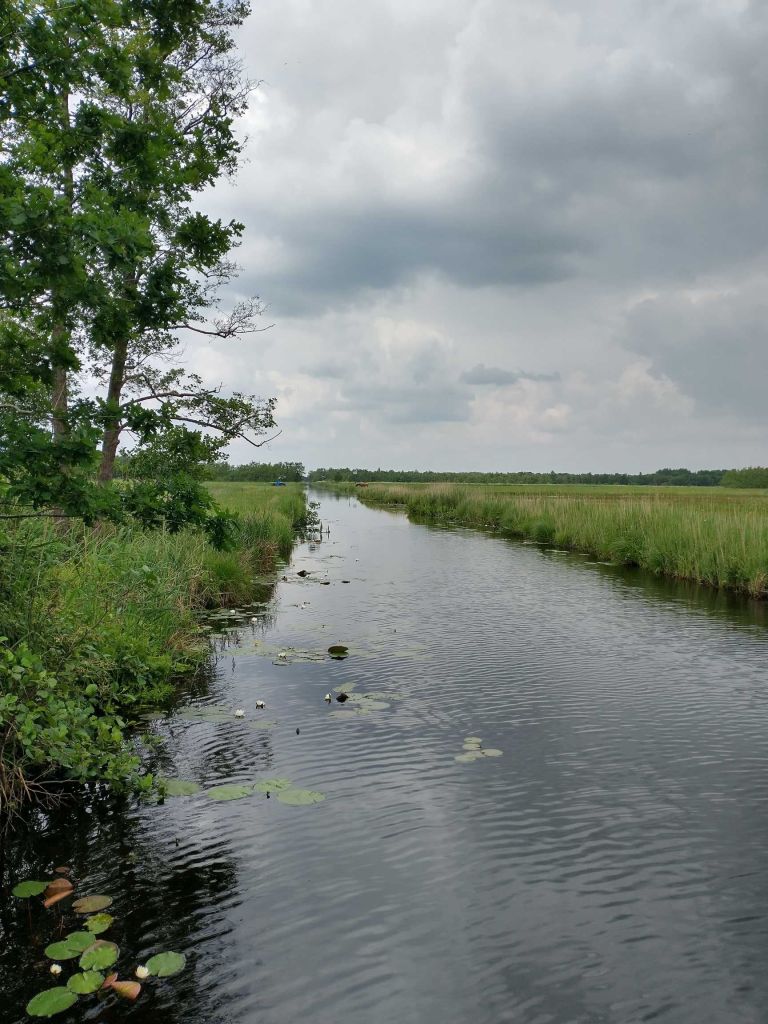
The first four letters of the word help to define it. A wilderness has to be wild, untamed, uncultivated and free from the influence and management of mankind. It is getting ever harder to find anywhere on this planet which has not been altered by humans but this national park, as natural as it might seem at first glance, has been almost entirely created by us. Originally this area was a land of peat and bog, and the Dutch harvested these natural resources, cutting the peat for fuel and the reeds for roofing. In some areas they dug too deep and created great lakes, and between them channels were cut and cleared as part of the transport network for moving goods around. Today the land would revert to bog and swamp without constant intervention and maintenance, and new waterways are regularly created.
To my mind a true wilderness has an edge to it, a frisson of danger and unpredictability, and you can’t help but be acutely aware that it is bigger than us, not something we can control. I realised that this was what was missing here. It had no edge. The human race was still firmly in control, although the role was now one of nurture and support rather than extraction for trade.
Regardless of how it was formed there was no doubt this was a haven for wildlife and a green and peaceful environment. It hadn’t quite satisfied my need to be in a wild place again but it was enough to enjoy it for what it was.
Hope all is well with you and see you again next week.
MJ
 The Olivia Rose Diaries
Do I detect a possibility of returning to France next year?
LikeLike
Hi Antony. More than likely, although we’ll give Belgium a second chance on the way perhaps.
MJ
LikeLike
I have never heard of this place. There is no wilderness in Holland, everything is managed. But there are some beautiful places. Looks like you found one of them.
LikeLike
Hi Tracey. I knew that but I sort of hoped it would prove me wrong. I guess the real wildness is the sea, and the IJsselmeer on a bad day! Not looking for that sort of edge!
MJ
LikeLike
I think there are fewer and fewer wildernesses on the planet. Perhaps in parts of Siberia or Canada or the Poles. At least the place you explored was no longer used for removing the natural resources. It’s not the same as it was once, but the wildlife is protected.
LikeLike
Hi Vanessa. Exactly, we’ll be grateful for what we have.
MJ
LikeLiked by 1 person
As humans continue to multiply, it will be harder and harder to find places that are truly wild that aren’t adaptable for human habitation. The desert, snow-capped mountains, Antarctica perhaps?
LikeLike
Hi Eliza. I know , but all a bit too extreme for me!
MJ
LikeLiked by 1 person
This micromanagement is so Dutch. They can not simply let nature be nature. As far as that is possible. It always makes me feel a bit claustrophobic. But your pictures are lovely and Weerribben is quite nice. Have you toured the Biesbosch? It is near Rotterdam but less managed. The first beavers were released there when Iwas little and have become quite successful 😊
LikeLike
Hi Gerlinde. Never made it to the Biesboch, but we may manage a quick visit before we head off back to France next Spring.
MJ
LikeLike