Hello and welcome to the latest blog from The Olivia Rose Diaries on July 5th 2023.
When we began our boating life it was on the understanding that we wouldn’t go to sea. Michael had spent the first nineteen years of his working life on ships around the world and so it was a familiar environment for him, but not for me. I was happy enough cruising on inland rivers and canals, or at least I hoped I would be, never having done it before, but I have never felt at ease on open waters, even more so if I lose sight of the land. This is an irrational fear, not one that is based on any particular incident, and I wish I didn’t feel so strongly about it, but I do.
Given that context, I’m not sure how I ended up crossing the IJsselmeer in force five winds on a stormy Sunday at the end of July. The IJsselmeer is the largest inland lake in western Europe, covering 420 square miles, and it has a reputation in keeping with its size. To my mind a body of water of that magnitude behaves like a sea regardless of what name you give it. It was formerly known as the Zuiderzee, a wild and unpredictable open sea with a grim history of shipwrecks and a coastline that was all too often ravaged by flooding. One of the earliest documents to record plans to seal this area off originated in 1667, but it wasn’t until modern technology arrived that it became feasible.
The idea to build a dam and reclaim the land was first proposed by Cornelius Lely, the Minister for Water and Management, in 1913 but it was opposed due to high costs and fears over how it would affect the local fishing industry. Then came the floods of 1916, followed by a famine in 1918, after which parliament accepted his proposal.
Work on the Afsluitdijk began in 1927, entailing the construction of a huge dyke 32 kilometres, or 20 miles, long. It took five years to build, employing at least 10,000 people, and relied on 27 large dredgers, 13 floating cranes, 132 barges and 88 tugs. On top of the dyke is a motorway that connects Den Oever in North Holland to the village of Zurich in Friesland. Once the dam was finished the sheltered body of water behind it was given a new name, based on the river that flowed into it, and so it is now known as the IJsselmeer.
We had considered crossing a week or so ago from the top of North Holland but the winds had been too strong to even contemplate it. I had breathed a quiet sigh of relief and put it out of mind for a while. However we were now heading towards Edam, going slowly, killing time until a better weather window might appear and we could cross into Flevoland from the southern end of the lake. That weather window turned out to be the last Sunday in July, with gentle winds of around 11 – 14 kilometres per hour forecast for the morning, rising slightly in the afternoon. Sunshine and blue skies had disappeared two weeks ago, leaving us with unseasonable autumn-like weather, but that in itself was no reason not to set forth. I stuck my head out of the door on Sunday morning and could immediately tell that it was a little windier than expected, but the trip shouldn’t take more than an hour and so I convinced myself that all would be fine.
And indeed it would have been fine if not for the fact that the weather took no notice of the forecast whatsoever, shrugging it off with disdain as being too dull, eager instead to flex its muscles and show us what it was made of. As we exited the lock and cruised out onto the open water, leaving the tree-lined avenues and cheerfully painted doors of the residential streets that lined the canal behind us, our world abruptly lost all its colour. The sea was slate grey, blending into a formidable, towering skyscape in hues of blacks and grey. Behind us, where the clouds met the horizon, I could plainly see the rain falling, darker smudges of black beneath the canopy, as if the artist had lost concentration for a moment and his brush had slipped. It would be a miracle if we didn’t get soaked.
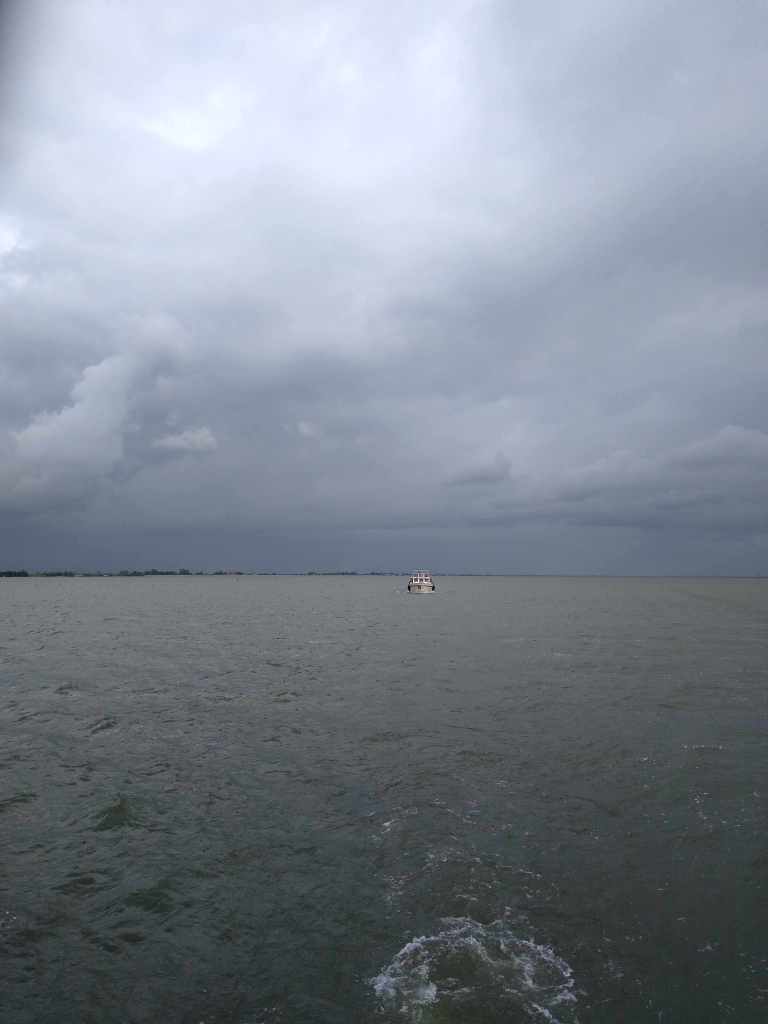
Despite the glowering skies the first half of the crossing went well, with Olivia Rose cutting a steady path through the water, Michael relaxed and in his element at the wheel. Our boat seemed to be enjoying herself and, much to my surprise, so was I.
This southern part of the IJsselmeer is also known as the Markemeer. Our guide to the inland waterways of The Netherlands had the following words of warning about this particular area:
‘.. in strong winds its shallow fresh waters are converted into an uncomfortable and difficult short sea, which should not be taken lightly, particularly when taken on the beam away from shelter.’
Looking around me I could see that where the sea had been lightly ruffled it now had small white horses on it. I could feel the wind more keenly on my face, cold and with a new edge to it. Within ten minutes the small white horses became bigger and Olivia started to wallow and roll. She had never been designed to go to sea and so it didn’t take much for her to become a very uncomfortable place to be. It was astonishing how quickly it changed, not just a factor of the wind getting up but also because the water was now bound by land on all sides which meant that the wave pattern changed. It became choppy, the waves short and deep.
Michael still seemed calm but his attention had sharpened.
‘The wind is up and we’re going to lose what little shelter we’ve had from the land in a minute,’ he shouted at me,the wind whipping the words from his mouth so that I struggled to catch what he said. ‘This rolling is going to get worse but there’s nothing we can do about it. We’re committed now.’
I could see he was right. We were so far across that there was no point in turning back. It was a case of grit your teeth and keep going. I should make it clear that this was an uncomfortable sea, not a life-threatening one, but it still transformed Olivia from a safe place into one that heaved and lumbered from one wave to the next, with the anchor banging against its housing and the spray flying. I sat on the wooden box where we store our spare ropes, wedged myself into the corner and held firmly on to the railing. Moving about the boat was out of the question. I soon decided that watching the next wave building up towards us wasn’t doing much for my peace of mind and instead kept my gaze on Michael. If he stayed calm, so could I.
Much of my fear of the sea has been based upon the unpredictability of the weather and how quickly it can change. So often it promises to be one thing and then changes its mind. On land this means parties and BBQ’s have to be moved indoors, the wedding photos aren’t quite what the bride and groom hoped for or, a worse case scenario, outdoor concerts and festivals are cancelled. It is obviously very irritating for everyone concerned. But when the weather decides to shoot up to force 5, instead of the force 2 that was expected, when you’re half way across the Markemeer, irritating isn’t the word that comes to mind.
Everyone who has a boat has a tale to tell. Our friends Ken and Karen, who came with us in their boat that day, had made the crossing on another occasion where force 2 was forecast but it soon turned into a force 4. Other friends have crossed the Channel on a day where wall-to-wall sunshine was expected and found themselves in a bank of fog. All of them say the same thing, that the weather didn’t behave as expected.
Some people enjoy pitting themselves against nature but I’ve never been of that mindset. I would rather work with nature and if that means leaving her well alone at times I can live with that.
I’m still glad that we did this crossing. It was important that I tried it, but having done it, a persistent little niggle that had questioned whether I was wrong to be so dismissive about literally broadening my horizons and that I might be missing out on something special was finally laid to rest. It was important that I tried it for my own self-respect which, ever critical, likes to slip into my mind at times with insidious phrases like ‘Don’t be such a timid little mouse, just do it’. It’s not helpful.
As we finally turned into calmer waters I felt a distinct sense of relief, one I knew was shared by all of us, but I also felt newly at ease with myself, able to rise above that little voice in my head. Each of us has our own comfort zones and I think it is important to push at those zones every now and then. However it is also important to learn where the limits are and I now understood where my boundaries lay. I felt stronger for knowing it. On the scale of comfort zones some people will empathize with my feelings whilst others will lie on either side and that is as it should be. We are all different and should be allowed to be so.
Armed with greater insight I feel sure that there will be occasions when I am happy to venture out onto open water. Hopefully the next time will be under blue skies and water that is as still as a millpond!
Now that I could actually move about the boat without falling over I went down to the galley. It looked as if a tornado had blown through it. Jars of herbs had flown off their shelf and onto the floor, some of them bouncing off the work surface and breaking in the process. Anything that could move was now on the floor: the frying pan and the kettle that we had left on the hob, even the draining board and washing up bowl. Glasses, mugs and bottles that were on a shelf with a lip to keep them in place had fallen over in situ with a couple of them breaking and a cupboard door had opened and spewed out the contents. Against all odds a vase with roses in it hadn’t fallen over. It had walked itself to the very edge of the shelf but we had turned in to sheltered waters just before it reached the point of no return. Michael tutted in annoyance as he surveyed the mess.
‘We should have made this lot secure before we crossed. If I had thought for one minute it was going to be that rough I would have put everything down on the floor. It would still have fallen over but we wouldn’t have had so many breakages.’ He shook his head again. ‘I’m annoyed with myself.’
Twenty minutes later we were moored up on the Large Waart canal. The wind continued to rise throughout the afternoon, white horses cresting the waves and the wind thrashing through the trees in a temper because we were out of his reach. I sat inside with a recuperative mug of tea in my hand and let him rant. All was well.
 The Olivia Rose Diaries
As you can say one should take forecasts at sea with a pinch of sea salt. My experience was leaving North Spain for France with a personal phone call forecast from the Met Office of Force 2. In the event we were caught out in a Force 12, Hurricane Force, in the middle of The Bay of Biscay. We lived to tell the tale – just!
LikeLiked by 1 person
Hi Antony. Makes our force 5 seem like nothing. I can’t imagine how it would have been!!!!
MJ
LikeLiked by 1 person
Whew, rather hair-raising by the sounds of it. Glad you made it safely, despite the breakages below. Better them than you! I think I’m in your park, preferring sunny days and calm waters!
LikeLike
Hi Eliza. Indeed! Still grey and wet though- driving us mad!
MJ
LikeLiked by 1 person
I’m glad you made it okay! I would have been a quivering wreck. I’m not keen on going to sea at the best of times. One clearly has to be sceptical about the weather forecasts. I hope the clearing up operation wasn’t too bad.
LikeLike
Hi Vanessa. Clear up not too bad thank you. Will be glad when we get some better weather though.
LikeLike
Oh my word. I think ‘brave’ is the word! There is now way I could have done what you did. I take my hat off to you Mary-Jane. Weather on the water is so unpredictable. We actually travelled along the roadway you mentioned, dropped down into the parking area and took some photographs and that was good enough for me as the water was full of white horses then. Hopefully the rest of your journey will be on calmer waters. Take care both. Happy travels. It was good to catching up with you both, and thank you for a delicious lunch.
LikeLike
Hi Ann. It was lovely to see you both. Much calmer today. But still too wet!!!
MJ
LikeLike
Reminiscent of our journey from the Norfolk Broads to Calais! Happily enjoying the French canals from our base in St Jean De Losne after a fab trip from Valenciennes. Really enjoying reading your updates!!
LikeLike
Hi Barry. Glad all going well on your travels. Hopefully not too much weed or drought problems?
MJ
LikeLike