Hello and welcome to the latest blog from The Olivia Rose Diaries on June 3rd 2023.
I seem to have gone overboard on the videos this week, but there has been so much to see and it is a good way to share it with you. We’ll begin with our final day on the River Linge and some irresistible Graylag geese families and their chicks.
Moving on to another subject, we seem to be spending almost as much time studying charts and trying to work out which route to take as we do actually cruising. The Netherlands is proving to be very different to France in so many ways, key amongst them is the sheer volume of water and the bewildering choice of navigable routes.
Some routes are predominantly commercial, particularly on the big rivers, whilst others are more suited to craft smaller than us, some with bridges so low that you can hardly squeeze a canoe underneath them. Water depth is another factor to take into account, with shallow waters on some of the large lakes, where we would soon run aground if we strayed off the recognised channels.
There are locks in the Netherlands, more than I expected, but they are far outnumbered by the bridges and these will also dictate whether a waterway is open to us or not. Some bridges are fixed but many of them lift or swing if they are too low for most boats to pass under.
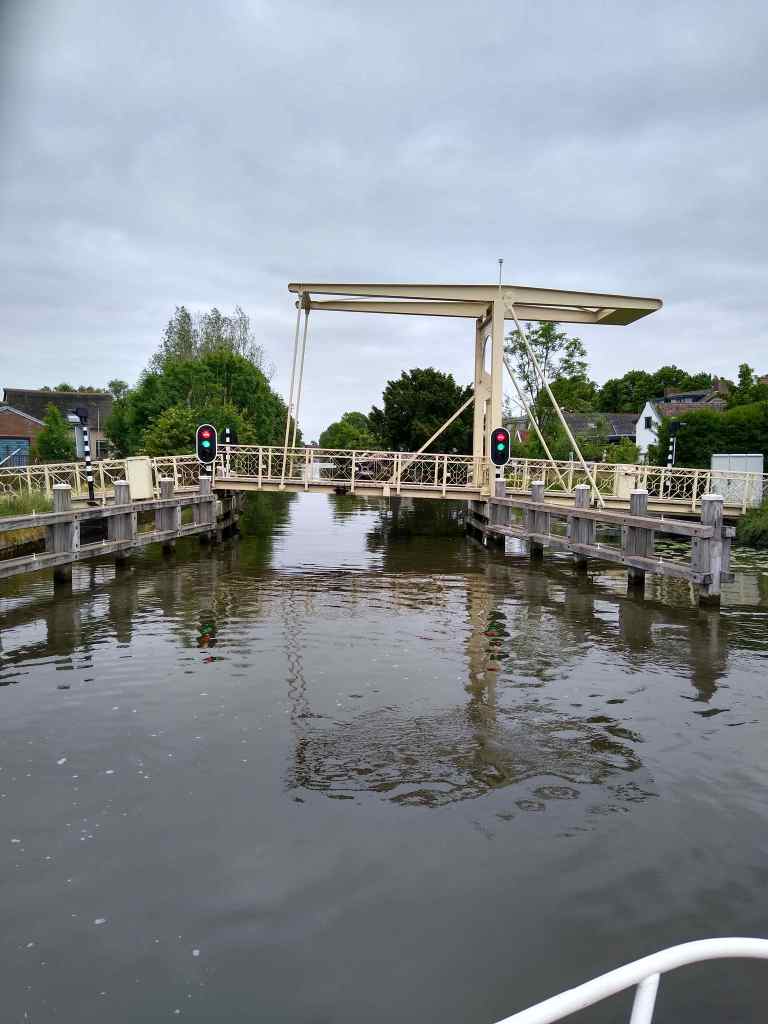
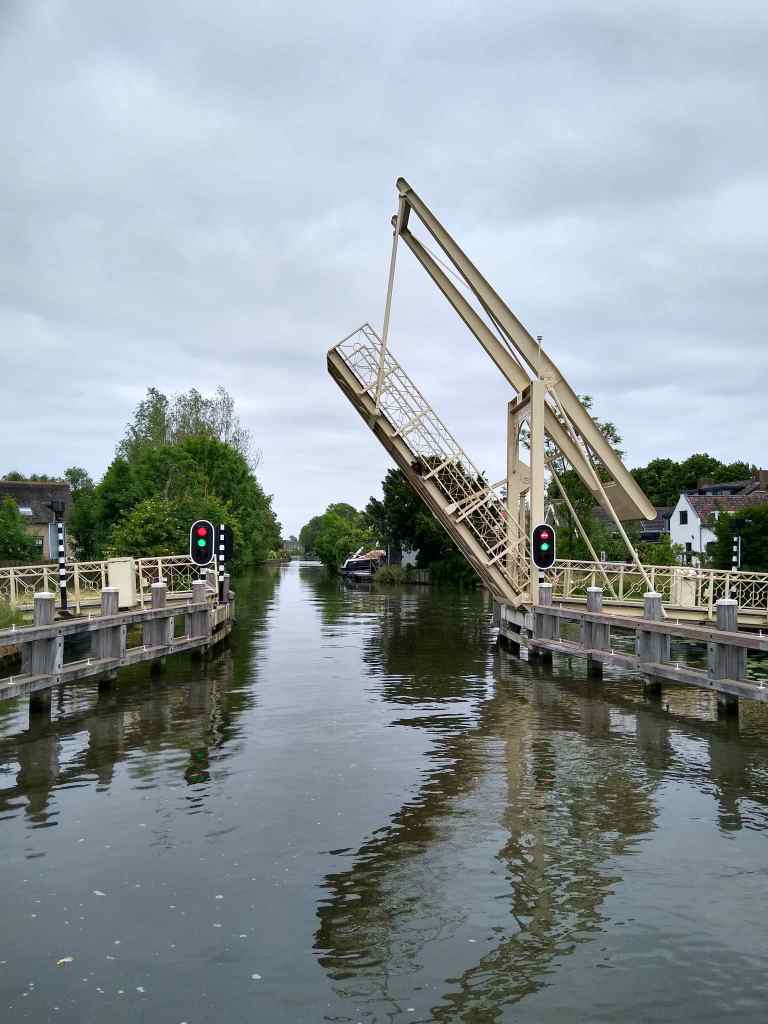
These bridges are operated in a variety of different ways and each days presents new conundrums . There might be a person in a hut by the bridge, or there might not. There might be a button cunningly hidden right up close to the bridge which we need to press to alert the remotely controlled system that we are there, or there might be cameras that see us coming and everything happens automatically. Some of the bridges have a VHF number we can call and at one bridge the operator lowered a wooden clog on a long stick for us to pay a 2 euro fee. And then there are the times when none of the above seems to work.
A system of traffic lights by both bridges and locks controls the flow of boats, in much the same way as they do on roads for cars. A single red either side of the entrance means stop and wait, a red and a green means it is being prepared, and a green means go. Simple. Or perhaps not.
‘So what does that mean?’ I asked in exasperation as we came up to a lock with four red lights on it.
The Dutch boat in front of us took one look at the lights, did a sharp u-turn, yelled out across the water that it was closed and signalled that we should follow them round the corner to the big commercial lock and go through that. The next day we came across another set of four red lights, the reason this time being that this bridge opened for half an hour only at set times during the day. At a bridge only a few kilometres further on there was a fault with the camera system and it took them six hours to fix it, which caused a tale-back of boats in both directions.
Below is a video of a bridge that worked perfectly.
Six years of cruising has taught us that patience is not just a virtue but a pre-requisite for a happy life on board. We’ve also realised that learning how things work in a new country is surprisingly time-consuming, can be wonderfully energising but also a little exhausting! Thinking back, this is exactly how it felt when we first began cruising in France. After a couple of seasons we had gained enough experience to know how most things worked most of the time and I am sure it will be the same here in the Netherlands.
The final video is of the famous weekly cheese market in Gouda, so named not because the cheese is made here, but rather as this was where it was bought to market.
This weekly ritual is unashamedly a show for the tourists as these days contracts are agreed before the cheese is even made. The man in the flamboyant yellow suit is explaining how the cheeses were bought to market by horse and cart each week, weighed and then traded. Traditionally this was done by a distinctive clapping of the hands: the process of negotiation was marked by a clap between the buyer and the seller until a mutually acceptable price was reached. A final shake of the hands sealed the deal and the buyer left with his cheese. As we peered through the crowds, trying to get a clear view of what was happening, men in blue or white smocks clapped hands and glared at each other ferociously as they carried out a mock auction, much to the delight of the crowd.
I found it hard to take my eyes off the handsome horse, who stood so still that at one point I began to wonder if he was real.
And that about wraps it up for this week. Next time you sit at a red traffic light in your car, spare a thought for us! See you soon.
MJ
 The Olivia Rose Diaries
Interesting post this week, MJ. New things to learn always in a new place… the locks and bridges seem challenging! I, too, noticed the stillness of the horse and had the same thought. Most horses are rather fidgety. 🙂 Gouda is one of my favorite cheeses!
LikeLike
Hi Eliza. We’ve done what you do in a cheese market and bought a smaller version of the big rounds to see how the real thing tastes. Horse was gorgeous.
MJ
LikeLike
Everywhere looks very tranquil, no rush to do anything, except perhaps the cheese market!
LikeLike
Hi Trish. Yes, a place to unwind.
MJ
LikeLike
Sounds as if you need a degree in astrophysics to work out all the navigational conundrums! The horse is lovely. The theatre at the cheese market sounds very similar to the procedure at the truffle markets around here.
LikeLike
Hi Vanessa. It’s fair to say there’s a lot to learn! But it’s still great fun.
MJ
LikeLiked by 1 person
The Netherlands looks fascinating. Beautiful waterways and I love all the bridges. Yes my eyes were glued to that stunning horse and so interesting to hear about the old ways of selling cheese at market. A truly fun trip 😘
LikeLike
Hi Fiona. Yes this is being a lot of fun. I didn’t really know what to expect and it keeps surprising us – in a good way!
MJ
LikeLike