Hello and welcome to the latest blog from The Olivia Rose Diaries on 10th February 2026.
Every now and then life throws a lesson our way, often completely unexpected, perhaps even trivial, but at times it can be something to take note of. At times it might lead to a change in behaviour or a way of thinking.
Late January we left our house-sit in Strasbourg, breaking our journey back to Le Shack with a couple of nights on Olivia Rose, moored on the Rhone at Valence, to check that there were no leaks and that the ropes were holding up. When we left her last October we had prepared her for winter, so the water tanks were drained and everything had been taken off the decks (solar panels, outboard motor, bikes, empty plant pots, and various other bits and bobs) and stored inside for safekeeping. This meant that we would hardly be able to move down below and wouldn’t have any running water on board, but we were only going to be there for a couple of nights. The marina facilities would be available and we could easily pop to the shops for bottled water whilst we were there.
We arrived to find that Olivia Rose was fine, but unfortunately the same couldn’t be said of us. We had picked up a nasty coughing bug at some point during our stay in Strasbourg and by the time we reached the boat it had completely wiped us out. Never in our lives have we spent so much time being racked by violent coughs, a peaceful night’s sleep becoming a distant memory, and our body thermostats in turmoil, although interestingly in different directions with Michael hot and feverish and me needing to wear three fleeces, a combination of scarves, and diving beneath a pile of blankets in bed just to keep warm. Apparently most of France was coughing, and this was certainly in evidence on our train journey down to Valence. We were surrounded by people looking hot and feverish, all of us sharing that particularly anguished expression when you are trying desperately not to cough in a public place. If we hadn’t already been coughing along with with many of the other passengers we would surely have caught this bug then anyway.
We were in no fit state to travel onwards, so we decided to stay put for an extra week until we felt better. At least we would be in our own familiar space, if rather crowded, but still the best place to be when feeling unwell.
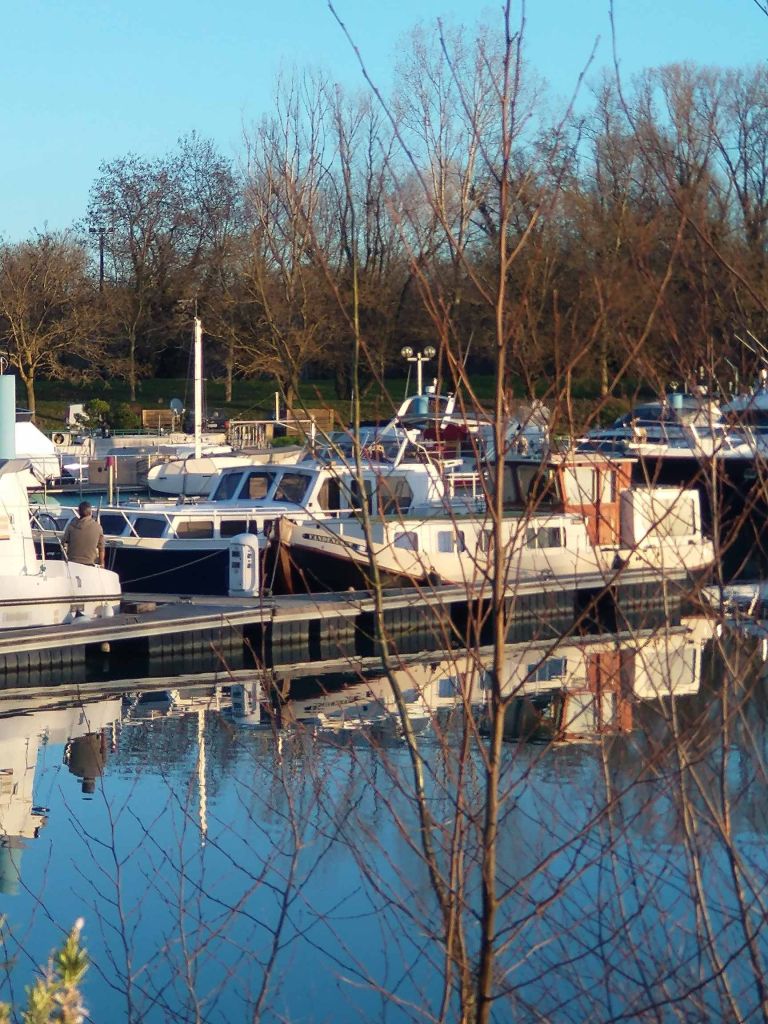
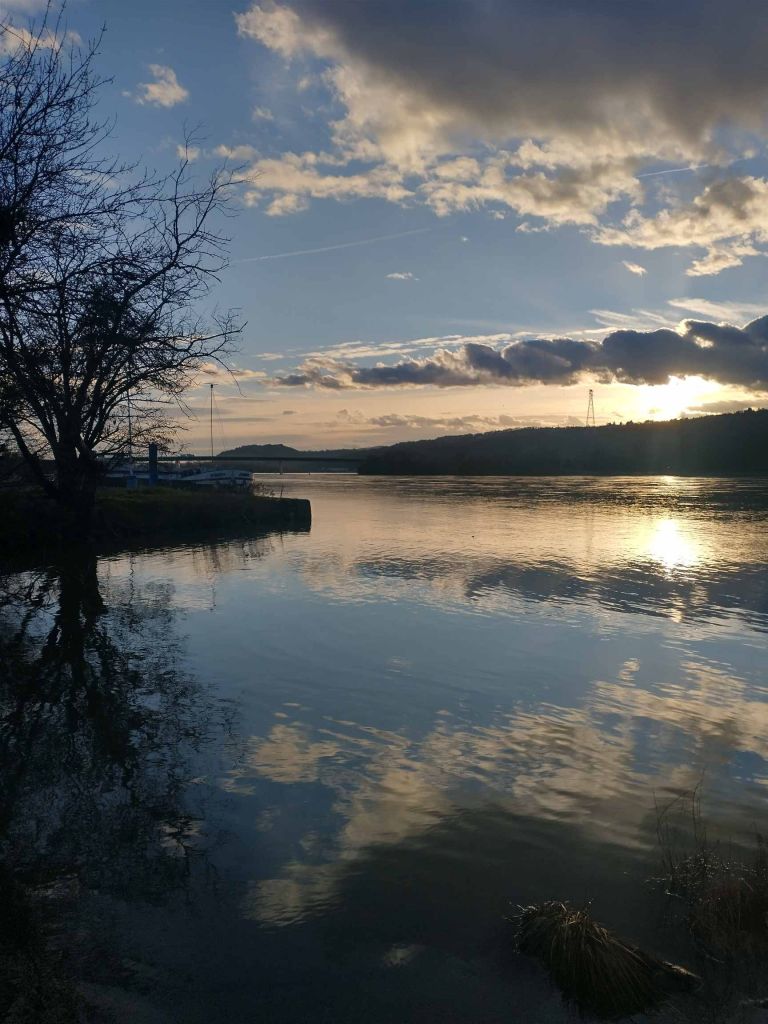
At this point I was feeling a bit better than Michael so water duties fell to me. Armed with a couple of empty water bottles for doing the washing up I turned on the tap at our nearest supply on the pontoon. Nothing came out. This was unexpected. If temperatures got very low in winter the water might be turned off temporarily to avoid frost damage, but it was actually quite warm and pleasant. I carried on walking for a couple of hundred metres to the shower block to find a large notice pinned to the doors. They had suffered a major leak overnight and as from today it was closed. No toilets, no showers, no access to a tap of any kind. We were on a boat on a river, surrounded by water, but with not a drop to drink.
Reading on further the notice informed me that the problem was so complicated that the facilities would stay closed until March.
I had to read that last bit twice. I didn’t see how anything could be so bad as to take that long to fix and there were plenty of people who lived full-time on their boats in this marina who simply couldn’t be left completely without water. By now I needed to go and have a rest so I trudged back to the boat and told Michael the news.
I hadn’t fully appreciated how much I took water for granted until it wasn’t there, or how panicky I felt at the thought of running out. We always left a few bottles of water on board so that we had something to tide us over on our return, but as I made a cup of tea it was obvious that we had enough for just one more day. Given how weak we both felt, and how heavy water is to transport, the trip to the supermarket, either 30 minutes each way on foot or a much more appealing ten minutes by bike, seemed a daunting task. We had no support network: we didn’t know anyone and the people on our pontoon who lived aboard their boats had so far kept their distance, happy to say hello but not much more.
So this was our life lesson for the week, an interesting one on several fronts. Beyond all else it made me understand not just the importance of water, but also how much we need on a daily basis just for drinking and cooking – a couple of litres disappears horribly quickly. It reinforced a point I have always known, how things that are normally so easy when your health is good become so difficult when you feel unwell, and lastly it showed how important it is to be able to rely on other people, strangers or friends, when things go awry.
We managed. We took it in turns to go and get food and water. Later on that day they turned the water on at the pontoon, although it came out a rather worrying orange colour to start with, but we had something for the washing up at least. And five days later they fixed the leak and the shower block re-opened. Luckily for us we have our own onboard system for the toilet. Lastly, I am sure that if we had really struggled to get food and water, one of our fellow boaters would have been willing to help. People are usually kind when the need is dire.
Just over two weeks later we are back at Le Shack and feeling much better, if not quite back to normal yet. It would be so easy to move on, to forget all about it. After all what are the chances of the same thing happening twice, being ill and having no water? At best we should make an effort to increase the number of bottles we leave on board so we can last a bit longer if we ever had to.
We might have done no more than that, except that this is not the first time this year that we have come across a situation where the water supply has failed, although luckily for us we missed it by a couple of hours. We left one of our earlier house-sits in Haywards Heath in the UK at lunchtime and all was well. By mid-afternoon the water supply failed, suddenly and with no notice, and thousands of homes were without water. The family who we had been house-sitting for came home from holiday to find no shower, no flushing toilet, no water to drink and with no firm idea of when the problem would be solved.
I recently read a fascinating, and also disturbing, article about this subject and how it is a recurring problem in various parts of the UK. People have shared their problems and experiences on social media: how it feels not to shower for days and to have no working toilet, how impossible it is to keep babies and children clean, more hygiene issues with dirty dishes and clothes. Schools, surgeries, pubs and restaurants, various local businesses all forced to shut. And what about hospitals? They talked about long queues at the bottling station, until they eventually ran out of supplies, the same with empty shelves in the supermarkets, and people stealing water if it was left unattended. To begin with people helped each other, but as the situation continued social norms and niceties began to break down.
The supply problem was blamed on a lack of long-term investment and bad management, a situation exacerbated further by the recent storms and freezing temperatures. This region was not the only one with serious problems as apparently Thames Water is on its last legs. Imagine the health risks and chaos if millions of Londoners were without running water.
We live in France and I am not aware of a problem here yet but even so we’ve decided to do something as a result of our recent experience and in many ways it’s just a natural extension of our off-grid life, the self-sufficient way that we try to live at Le Shack. We’ve ordered a 300 litre drinking-water tank and we’ll keep it as a back-up, hoping that our mains water supply will run perfectly well for ever more, but with the reassurance of another option if it were needed. Assuming an overly generous ten litres a day for drinking and cooking, it would tide us over for a month, more if necessary, hopefully enough time for the supply to be fixed. We’re not being doom-sayers or getting paranoid, but we have seen that the systems we all rely on and take for granted are far more fragile that we realise. This just seems a practical step to take.
One last thought before I leave you this week. You may recall at the end of the last blog that I wondered how it would feel coming back to our simple life at Le Shack after a few months in houses with all mod cons. After ten days on a boat with no running water and barely room to swing a cat, I can honestly say Le Shack feels like a palace! I turn the tap and water comes out of it! It’s such a novelty I find myself doing it just for fun. Granted it’s not hot water but that’s normal for us and a mere detail…..
All’s well that ends well I guess and it’s great to be home. See you again soon.
MJ
 The Olivia Rose Diaries
Well done getting a water tank… we now have a generator for ‘ just in case’… Hope you recover fully soon. Hugs to you both ❤️
LikeLiked by 1 person
Hi Fiona. Good idea on the generator. If it keeps raining like this we’ll need to add a canoe to our ‘just in case’ list. Getting better every day thank you. MJ
LikeLiked by 1 person
Lots to think about in this very thoughtful blog!
LikeLike
Hi Antony. I think it does no harm to stand back and look at things differently occasionally. MJ
LikeLike
I’m sorry to hear that you were both so ill, and I hope you feel much better now. We take so many things in modern life for granted that we are lost when systems break down. Good for you getting a drinking water tank. A few years ago, our local water company declared the tap water unfit to drink after heavy rain washed a load of slurry into it. We had to do a round trip of about 14km to collect our quota of bottled water. A tank would have been a godsend then!
LikeLike
Hi Vanessa . That sounds like a nightmare. Our tank arrived today. Now we just have to fill it!!
MJ
LikeLiked by 1 person
Oh, my, what an ordeal! Your cautionary tale is a word to the wise. Water is a vital and precious need for life, yet it gets little notice. If you dig into the truth, many water systems worldwide are teetering. I think there should be a lot more press about the situation, urging conservation at the very least.
Meanwhile, enjoy your free-flowing water and the coming spring. I imagine your days are growing warmer, at least warmer than ours!
LikeLike
Hi Eliza. Thankfully it is indeed warmer but we have extreme weather on the way, winds of 60kph and gusting 110kph this evening. Going to be a noisy night.
MJ
LikeLike
You’re neither a doom sayer nor paranoid: a good water tank never is a bad decision. Most of my sailing has been offshore, so water tanks were a necessity, especially for longer hauls, but I know a few people who’ve taken refuge in their boat after nature disrupted regular life; there are plenty of reasons to have water tanks available — as you learned.
Even now, living on land, I know what a hurricane or long-term freeze can do to water supplies. Without electricity to run the civic pumps, the flow stops. I just counted; in my little ‘supply nook,’ I have fourteen gallons of drinking water. As the old saying has it, “An ounce of prevention is worth a pound of cure!”
I hope the tank goes in easily, and that you’re feeling much better!
LikeLike
I like that old saying. Wise words indeed.
MJ
LikeLiked by 1 person
Hi MJ!
Happy to hear that you are both on the mend and arrived home safely.
There are a lot of respiratory viruses going around here in New Hampshire as well. Lousy that you had no water when you were not feeling well. Due to construction on our road, the water has been turned off periodically. They give us advanced notice but you don’t realize how often you go to turn on the tap or flush a toilet until you can’t. I fill jugs of water to get us through but it is still unnerving to go to find an empty tap when you turn it on. Smart of you two to think ahead and install the water tank.
LikeLike
Hi Kerry. It seems the world is a small place and we share everything! MJ
LikeLike
These communiques are so interesting. Many of us living vicariously aboard ship 😎
LikeLike
Hi Darryl. Glad you are enjoying them. Taking the rough with the smooth! MJ
LikeLiked by 1 person